
十二怒汉
Trapped in Gaza for 2 weeks, hundreds of American citizens still not able to leave_我的网站

一 |
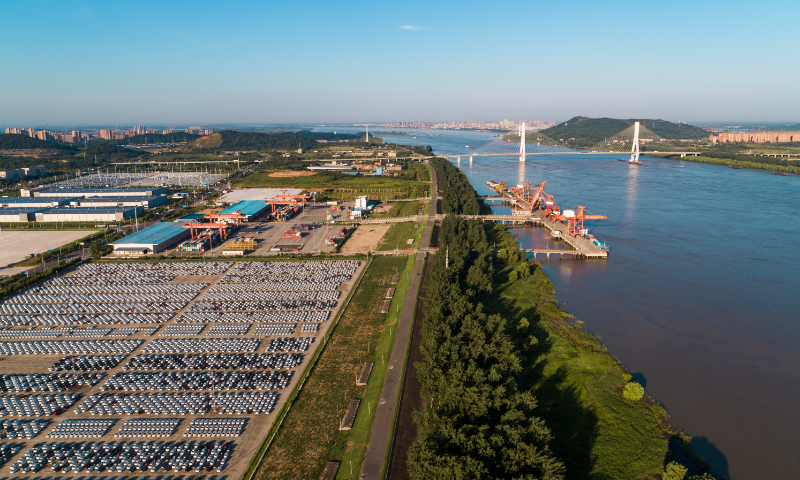
Global automakers are forging deeper and longer-term ties with China, as the country's role evolves beyond a key market into an increasingly important hub for automotive research and development (R&D) and innovation.
SAIC Motor and General Motors (GM) signed an agreement on Wednesday to extend their joint venture partnership by 20 years to 2047. A month earlier, Honda Motor and GAC Group signed a strategic agreement to renew their joint venture (JV) partnership in GAC Honda, extending their cooperation to 2038 while keeping the existing equity structure unchanged.
The renewed commitments to China by global auto giants signal more than confidence in the long-term potential of the Chinese market. It reflects China's evolving role in the global auto industry, from a manufacturing base and sales market to an increasingly important source of innovation and technologies that shapes the future of mobility, Peng Bo, a research fellow at the Chinese Academy of International Trade and Economic Cooperation under the Ministry of Commerce, told the Global Times on Sunday.
Behind this shift is the rapid rise of new-energy vehicles (NEVs) and vehicle intelligence, as global competition increasingly centers on batteries, electric powertrains, intelligent driving, automation, software ecosystems and artificial intelligence (AI), Peng said.
From market to innovation
Chinese automakers have accelerated their expansion into global markets. According to the latest data from the China Association of Automobile Manufacturers, China exported 5.096 million vehicles in the first half of the year, up 65.3 percent year-on-year, including 2.355 million NEVs, up 120 percent. In just a few decades, China's auto industry has evolved from learning from and introducing advanced foreign technologies into a major global force in automobile production, exports and innovation.
Such a picture would have been almost unimaginable several decades ago. At the time, China's auto industry was still in its early stages and lagged considerably behind global leaders.
In the 1980s, China began integrating into the global auto industry through the establishment of joint ventures. In 1984, Beijing Jeep, China's first Sino-foreign joint venture automaker, began operations, while Chinese and German partners signed the agreement for Shanghai Volkswagen. More global automakers from countries such as Germany, the US, Japan and France followed, bringing capital, technology, equipment and management expertise that helped accelerate China's auto industry development.
From annual auto production and sales of just over 1 million units in the mid-1990s, China saw the corresponding figures surpass 30 million units in 2025, ranking first globally for the 17th consecutive year. Auto exports also surged from just several thousand units to a record 7.098 million in 2025.
These figures illustrate the profound transformation of China's auto industry, which has evolved from a latecomer learning from global peers to a major manufacturing powerhouse and increasingly a source of innovation for the global auto industry, experts said.
Chinese experts attributed China's auto rise to its increasingly strong innovation capabilities. Sun Xiaohong, former secretary-general of the automotive branch of the China Chamber of Commerce for Import and Export of Machinery and Electronic Products, told the Global Times on Sunday that the close integration of R&D, manufacturing and market application has enabled new technologies to move rapidly from laboratories to mass production, while intense market competition has further accelerated innovation and product iteration.
Latest figures tell the story. China has led the world in automobile patent publications over the past decade, far ahead of the US, Japan and European countries. Patent publications in the NEV sector increased from more than 50,000 in 2016 to over 110,000 in 2025, with an annual growth rate of 17.1 percent. Intelligent connected vehicle patent publications rose from 44,000 to 93,000 over the same period, averaging annual growth of 11.6 percent.
In addition to the R&D capabilities, China's complete and highly efficient supply chain strengthens its industrial edge. The International Energy Agency estimates that battery electric car production costs are over 30 percent lower in China than in advanced economies, mainly attributed to lower battery cost and supply chain.
China's technology company Xiaomi only launched its first EV in 2024, but has quickly emerged as a major player in China's NEV market. Its strategy connects cars with smartphones, apps and smart home devices is creating a more integrated ecosystem. At Xiaomi's EV factory on the outskirts of Beijing, a new car rolls off the production line every 76 seconds on average.
Chinese automaker NIO's Hefei factory is known for its highly intelligent and automated manufacturing, using more than 700 robots and achieving an overall automation rate of 97.5 percent.
BYD's EVs can add 20 kilometers of range in just 10 seconds of charging and up to 400 kilometers in five minutes.
"These examples reflect a broader shift in China's auto industry, where strengths in advanced manufacturing, supply chains, software, AI and rapid technology commercialization are increasingly translating into a competitive edge," said Sun.
Cooperation not competition
The rapid transformation of China's auto industry has put growing pressure on some global auto giants. Honda CEO and President Toshihiro Mibe reportedly said after visiting an auto supplier factory in Shanghai, "We have no chance against this," Nikkei Asia reports.
Ola Kallenius, chairman of the board of management of Mercedes-Benz Group AG, told Chinese media that "In the world's most dynamic automotive market, you have to be here, and we're doubling down on China," People's Daily reported.
"Many major global automakers remain constrained by their long-standing reliance on traditional gasoline vehicles... Although they are pushing ahead with electrification, established technology systems, production networks and traditional development models have slowed," Jia Xinguang, an auto industry analyst, told the Global Times.
By contrast, China's auto industry has made a broad shift toward new technologies, building strengths across the industrial chain and establishing a mature and increasingly self-reliant core technology system, Jia said.
Against this backdrop, foreign automakers' approach to cooperation with China is changing.
Toyota's evolving China strategy provides a telling example. At the 2026 Beijing auto show, Toyota unveiled its "with China, for China" localization strategy, giving Chinese teams a greater role in management, R&D and product development, the Global Times learned from the Japanese company.
Toyota has expanded its China chief engineer team from four to seven, covering gasoline, hybrid and EVs across different segments. It is also empowering local management and deepening co-creation with Chinese partners to make development faster, according to the company.
A similar shift can be seen at Tesla, whose Shanghai Gigafactory is not only a major global production base, but also a key part of its global supply chain and product development. In the first half of 2026, the factory delivered nearly 468,000 vehicles, up 28.4 percent year-on-year. The Model Y L, led by Tesla's China team in design and development and manufactured in China, is also being rolled out in markets including the US, UAE, South Korea, Japan, Singapore and Australia, according to a press release that the company shared with the Global Times on Friday.
Foreign auto parts suppliers are also stepping up innovation in China. Bosch plans to invest more than 2.5 billion euros in AI development by the end of 2027, with much of its automotive-related AI work focused on China and Europe, the Xinhua News Agency reported.
Amid mounting challenges, China-foreign auto joint ventures are taking a long-term approach and actively reshaping their product strategies, R&D models and cooperation frameworks, Xinhua reported, citing Bi Wenquan, an executive vice president of FAW Toyota Motor Co.
These developments point to a broader shift: China's role for global automakers is expanding from "Made in China" to "R&D in China" and "innovation in China," making win-win cooperation increasingly important, said Sun.
For global automakers seeking to stay competitive in the next wave of industry transformation, turning competition into greater opportunities for cooperation with Chinese companies is increasingly becoming an "imperative" rather than an "option," said Sun.
As John Roth, GM senior vice president and president of GM China, said the renewed partnership "reflects the shared confidence of GM and SAIC in SAIC-GM and its long-term growth potential."
"It is not only about continuing what we have built together. More importantly, it is about building a more competitive, resilient, and sustainable business for the future," Roth said.
。 While extensive, international negotiations have now led to the release of four hostages captured by Hamas, scores of foreign nationals in Gaza, including as many as 600 Americans, are still being blocked by the U.S.-designated terrorist group from crossing into Egypt, according to Biden administration officials."To date, at least, Hamas has blocked them from leaving, showing once again its total disregard for civilians of any kind who are stuck in Gaza," Secretary of State Antony Blinken said in a televised interview Sunday.On Monday, State Department spokesman Matthew Miller clarified that the U.S. now assessed that after weeks of negotiations with Egypt and Israel aimed at securing safe passage for the Americans, only Hamas stood in the way."We do believe that Egypt is ready to process American citizens if they can make it to Egyptian authorities. Hamas just has to stop blocking their exit," Miller said.Miller also said that while U.S. officials were not in direct communication with Hamas, they have been urging Hamas to step aside in messages sent through "a number of partners."The Biden administration has been working since soon after the Oct. 7 attacks on Israel to reopen the Rafah gate -- the sole border crossing between Gaza and Egypt -- in order to move aid into the area and allow foreign nationals to leave.While a limited number of trucks carrying food, water and medicine were able to enter Gaza for the first time on Saturday, so far none of the foreign nationals has been allowed to leave.Miller explained that "a number of civilians, some American citizens" flocked to the Gaza side of the Rafah crossing when it was first opened, but none were able to leave because Hamas "was there blocking anyone from coming through the gate from the Gaza side out to the Egyptian side."According to U.S. officials, the Egyptian government has also been hesitant to allow civilians to exit Gaza through the Rafah gate because of the country's intense concern over security threats posed by terrorist activities on the Sinai Peninsula.Egyptian officials are also likely eager to avoid the optics of thousands of people pouring across the border from Gaza -- wary the country might appear complicit in what its president and other Middle Eastern leaders have said would be an "ethnic cleansing" of Gaza.While securing Egypt's cooperation in eventually facilitating the departure of American citizens would be a diplomatic achievement for the administration, it does not yet appear that Cairo has signaled it will extend the same opportunity to the parents, children, siblings, and partners of U.S. nationals in Gaza.Miller said it was still the administration's goal that the immediate family members of American citizens crossing through the Rafah gate would be allowed to depart as well, but that it was "an ongoing conversation" with Egypt.With a potential Israeli ground incursion looming, the already dire circumstances facing Americans and their loved ones inside Gaza may soon get even worse.Abood Okal, a 36-year-old American, has been stranded in Gaza with his wife and 1-year-old son since the beginning of the Israel-Hamas war, told his lawyer, Sammy Nabulsi, that the family has been huddled in a home with 40 other people, sleeping on the floor, sharing meager amounts of food, and that for an entire day, they had been forced to drink salt water to survive.Nabulsi said in an interview with ABC News Live on Monday that Okal's family had been instructed by the State Department to go to the Rafah crossing four different times, but on each occasion no one had been allowed to pass through the gate."I think the holdup is the United States isn't focused on this effort at all," said Nabulsi. "It's unacceptable to me. It should be unacceptable to every single American citizen is this entire country."Although the State Department asserts that Hamas is preventing them from fleeing to safety, Miller said Americans stranded in Gaza are "in a different situation" from the around 220 individuals the Israeli Defense Forces believes are still being held hostage by the group."I am not at all trying to minimize the situation," Miller said, acknowledging Americans like Okal and his family are facing "deplorable" circumstances and vowing that U.S. officials are "working intensively' to get them out.The administration has not provided any number or estimate of how many of the 500 to 600 Americans thought to be trapped in Gaza have reached out to the State Department for help."We have a list of Americans who are registered with us, and when we have any information about the possibility of transiting outside of Gaza, we're providing it to all of them," Miller said.。
Current article:http://xifo.guaxiazaopinduan.cfd/list_l5ixho5/m3iuz7.html
Published on:05:37:51
 成年玩家误充国产游戏上万元求退款 官方该通融一下吗
 第五人格IVL:ACT战队不鸣则已一鸣惊人,惊艳四座豪取冠军!
 一间小屋,装下109项邻里服务
 “김민석, 보급형 정청래될뿐”…‘女전두환’ 거론에 김재섭의 말
 拼多多。
拼多多。 '실종 허위종결' 담당 경찰, 한 달 뒤 경찰청장 표창
我的网站最新内容
- ·今日大雪,节气到底是什么?
- ·China speeding up Taiwan unification plan: Blinken
- ·BJ40增程首秀粤港澳车展 官改赤兔版亮相
- ·三个球队退役球衣加立雕像!詹姆斯的面子太大了
- ·Pentagon Exploring Stratospheric Balloons to Track Hypersonic Weapons - Reports
- ·彭勇任湖北襄阳市委书记
- ·A hug across 27 years:American teacher and Chinese desert fighter reunite and embrace with tears in China's Inner Mongolia
- ·French prosecutor: Alleged school stabber declared allegiance to Islamic State
- ·2025淘宝京东618确定6月20日结束,最便宜时间在6月17日晚8点到6月18日全天
- ·家长口中的“烂尾娃”,是多少普通人的人生
- ·樊振东德甲新赛季首秀:一单独得两分,率队3比1取胜!出场时全场爆发热烈欢呼声
- ·Trapped in Gaza for 2 weeks, hundreds of American citizens still not able to leave
- ·国产最强芯片!小米玄戒O3已开启规模化量产
- ·【观点】光大期货:成本端有支撑,硅铁期价仍以震荡运行为主
- ·Rudolph Isley, founding member of The Isley Brothers, dies at 84
- ·F1荷兰站排位赛:卫冕冠军诺里斯夺杆 维斯塔潘主场谢幕战仅第七发车
我的网站热点内容
- ·研究:蝙蝠身上发现的病毒与埃博拉病毒有关。
- ·科隆展汇总:《巫师3RE》重磅官宣 《FF7启示》新预告
- ·Salman Khan to Drop Battle Of Galwan Teaser on His 60th Birthday Tomorrow
- ·Jacinda Ardern将于本月完婚 在霍克湾举办私密小型婚礼
- ·直播间七夕“秒抢金饰”套路深,直播间七夕“秒抢金饰”套路深
- ·拼多多发布Q2财报:“新十年高质量发展”迈向新阶段,长期主义驱动产业价值跃迁,拼多多发布Q2财报:“新十年高质量发展”迈向新阶段,长期主义驱动产业价值跃迁
- ·夫妻吵架,怀孕妻子见红胎停,丈夫崩溃痛哭:备孕6年才怀上,孕8周还在打针保胎
- ·墨香迎远客 金石待知音 全国书法“蒲公英计划”扎根临平超山
- ·淘宝京东天猫2025年618红包领取口令是什么?618淘宝京东天猫红包活动最后一波结束时间是什么时候
- ·散户量化入门|免费解锁QMT量化软件交易功能(完整版攻略)
- ·20分钟!解放军在长江上架起千米浮桥
- ·西安机场新开杭州快递专线,西安机场新开杭州快递专线
- ·全国抗议示威造成交通瘫痪 毛利党:这是一系列抗议行动的开始
- ·优思益爆雷后,哪些明星网红道歉退款了?
- ·重返历史杀鬼子!国产抗战FPS《抵抗者》新预告发布:浴血守长城
- ·体育营销Top10|李宁发布亚运会中国队领奖装备 全红婵代言黄子韬品牌