

- 博客访问:5609
- 博文数量: 814
- 用 户 组: 普通用户
- 注册时间:2026-08-26
- 认证徽章:
傲慢与偏见


- ·2 individuals sentenced in China for illegal sale of controlled stimulants following US intelligence tip-off
- ·What we know about the Americans killed in the Israel-Hamas war
- ·建昌县实现“一事跑多窗”向“一窗办多事”转变
- ·Notorious Yasukuni Shrine visits draw opposition from China and SK, serve as ‘mirror’ laying bare Japan’s resurgence of neo-militarism
- ·美国AI实验室面临中国廉价竞争对手的挑战,开放模型需求正在飙升
分类: 九品芝麻官
摆渡人
How a Chinese game scholar connects ancient texts with modern play_我的网站

A |
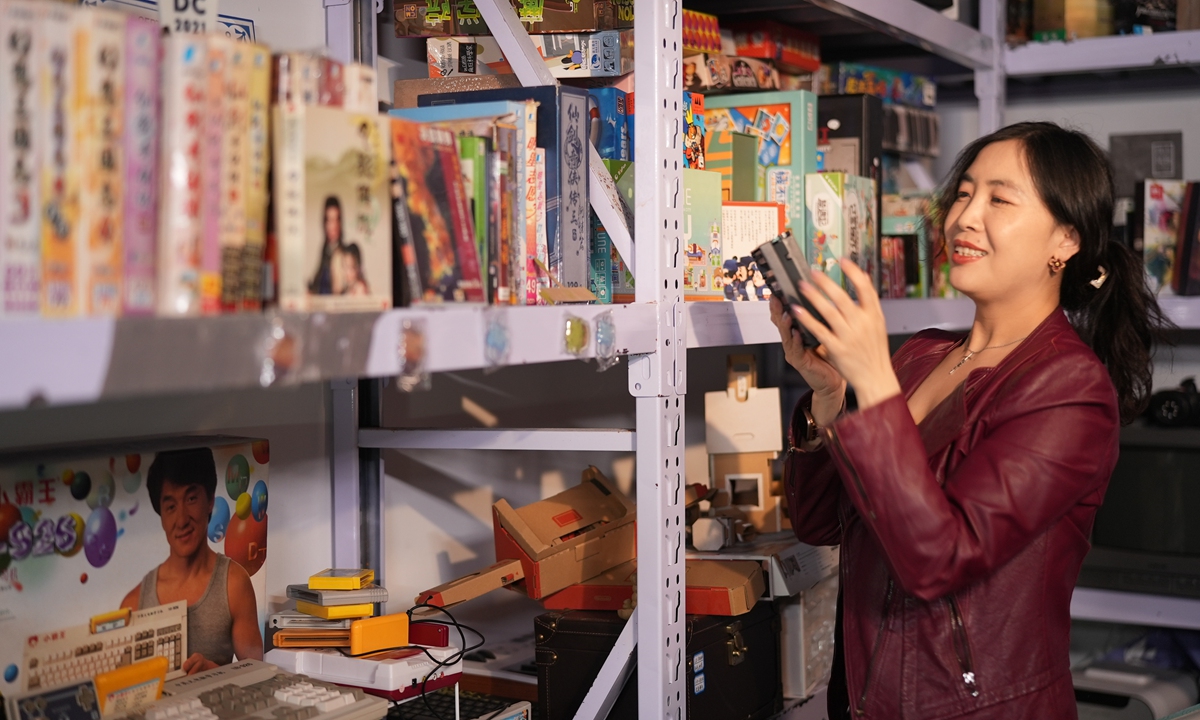
Inside Beijing's Homoludens Archive, shelves are filled with books, game consoles, game cartridges and other materials tracing the history of video games. For Liu Mengfei, the archive's director and chair of the academic committee of the Gamification Professional Committee, these collections preserve more than the evolution of games, they also capture the cultural memories of a generation.
A PhD in history from Tsinghua University, Liu has spent more than a decade studying the social impact of games, the role of games in history and digital humanities. Throughout her career, she has continued to explore the relationship between games and people: Why do humans create games? And how do games shape culture and society?
Books, meanwhile, have been an important gateway through which Liu has come to understand the world of games.
"The real value of a book lies not simply in what it tells you, but in whether it can change the way you understand the world and people," Liu told the Global Times.
Books meet games
In 2007, being an undergraduate history student, Liu wrote her thesis on the links between ancient Celtic religion and modern digital games.
To study original sources such as The Gallic War by Roman author Julius Caesar, she taught herself Latin. As her research extended into modern games, she also began reading the rulebooks of Dungeons & Dragons, a tabletop role-playing game.
"From historical texts to game rulebooks, these reading experiences seemed to belong to completely different worlds, but they gradually led me to realize that games are not simply entertainment products. They also contain history, culture and the relationships between people and society," she said.
Later, Homo Ludens, by Dutch historian Johan Huizinga, further transformed the way she understood games. The book gives a theory that humans are not only Homo sapiens, or "rational beings," but also Homo ludens, or "playing beings," and that games are deeply intertwined with human culture, from language and art to religious rituals and sports.
The book had a profound influence on her. It points out that the foundations of human society — language, civilization, religious rituals, sports and art, are all connected to play and games, because we are Homo ludens, "the playing human."
"The idea prompted me to view games from a broader perspective," Liu said. "Games are not an appendage outside human civilization, but are deeply connected to cultural creation and social life."
"It also showed me that games and game-based thinking could extend into broader fields, including education and technology," she added.
She later read other works on game studies, including Play Between Worlds: Exploring Online Game Culture, Half-Real and Rules of Play Game Design Fundamentals. Play Between Worlds, in particular, opened up another possibility for game studies at a time when discussions about "internet addiction" were prevalent in China.
"Games are not simply a form of entertainment that needs to be restricted or criticize;. they can also serve as important media for storytelling, cultural expression and exploring relationships," she said.
These reading experiences gradually shifted Liu's focus from simply asking "What are games?" to a deeper question: What can games bring to people?
Beyond time and technology
Periodically, Liu still returns to Homo Ludens in her free time, finding new insights from the book as society changes. In the age of artificial intelligence, she has revisited one of its fundamental questions: As AI becomes increasingly capable of handling repetitive tasks and surpasses humans in efficiency, what does it mean to be human?
"As AI takes over more monotonous and repetitive work, the time freed up should be devoted to creativity, experience and human relationships," she said. "The time we gain should actually be used to become better at 'playing humans.'"
For Liu, this also requires people to maintain their ability to think, imagine and reflect -- abilities that cannot be gained through simply receiving information. This has also prompted her to reconsider the meaning of reading.
In an era when AI can quickly summarize an entire book, Liu believes people still need to read the original works in full, because the value of reading lies in more than simply acquiring knowledge and conclusions.
"Reading a book is like a form of cultivation. You have to immerse yourself in it, patiently allow the author to take you on a journey, and find your own island along the way," she said.
For Liu, the value of reading is not limited to books on paper. As media evolve, so do the ways people encounter stories and understand culture. Some digital works are now becoming new vehicles for reading.
Chinese-developed games such as Genshin Impact contain hundreds of thousands, and even more than a million Chinese characters of text, while Black Myth: Wukong uses its "Journal" system to tell the stories of individual monsters through written entries.
"Digital games are carrying forward traditions inherited from literature and film, becoming new gateways, through which young people can enter the worlds of literature, history and traditional culture," she said.
"An important reason why Black Myth: Wukong has succeeded in communicating Chinese culture is that it does not simply insert traditional cultural symbols into a game. Instead, it draws on the original Journey to the West, contemporary works inspired by the classic, as well as the game's own rules and interactions, allowing players to develop a new understanding of traditional culture through their actions," she noted.
For Liu, the forms of reading may change, but the desire to understand the world and discover oneself will not. From books to digital worlds, what matters is not only what people read or play, but how they think, create and find meaning through these experiences.
。 成都8月21日电 (记者 刘忠俊)经过约10小时的紧张施工,成渝中线高铁全线首条接触网导线架设于8月21日凌晨顺利完成,标志着成渝中线高铁“四电”工程正式进入攻坚阶段。

B | 成渝中线高铁全线首条接触网导线架设现场。记者 刘忠俊 摄 成渝中线高铁是中国“八纵八横”高铁网沿江通道的重要组成部分,线路自重庆枢纽重庆北站引出,向西途经重庆市两江新区、沙坪坝区、璧山区、铜梁区、大足区,以及四川省资阳市、成都市,最终引入成都枢纽成都站,正线全长约292公里,设计时速350公里。

C | 记者在成渝中线高铁简州站至乐至站区间施工现场看到,随着施工负责人一声令下,恒张力放线车缓缓启动,以每小时3公里的速度匀速行进。

D | 在作业车和施工人员配合下,起锚、放线、滑轮悬挂固定、线索终端制作、落锚及中锚架设等一系列标准化操作依次完成,首条长1257米的接触线架设完成,经检测,各项数据一次达标。正在架设接触网导线的成渝中线高铁简州站至乐至站区间。记者 刘忠俊 摄 据了解,铁路“四电”工程(通信、信号、电力和牵引供电)被称作铁路的“中枢大脑”和“动力之源”,是铁路建设的最后一道关口。

E | 接触网是牵引供电系统的重要组成部分,位于列车车体上方的接触线被称为列车的“动脉”,列车运行所需的电流即通过接触线输送,其平直度、张力及空间几何参数直接关系到列车运行安全。“为确保架设进度与施工安全,项目团队采用BIM技术对接触网架设区段进行预先识别,有效规避线索交叉施工风险。项目部采用恒张力放线设备,通过实时监测并动态调整架线参数,将导线平直度误差精准控制在0.1毫米以内。”中铁电气化局成渝中线项目部副经理孙勇介绍。

F | 技术人员正在监测架设接触网导线拉力变化情况。记者 刘忠俊 摄 接触网导线架设是成渝中线高铁建设从线下工程逐步转入线上电气设备安装的关键阶段。“按施工计划,成渝中线高铁全线将完成742条公里的接触网导线架设任务,其中四川段483条公里,重庆段259条公里。”长江沿岸铁路集团四川有限公司相关负责人表示,目前全线路基、桥梁、隧道工程基本完成,新建站房主体工程已全部完成,剩余装饰装修和安装工程正有序施工,全线预计2026年年底前进入联调联试阶段。
Current article:http://xifo.guaxiazaopinduan.cfd/497rve/twf.html
Published on:10:52:39
- Kindle卖这么贵 还赔钱:都因为一家垄断全球的中国厂商
- 碳纤维前铲/桶椅/轮毂等 仰望U9碳纤维个性化选装套件开售
- 长江电力:中国三峡集团累计增持公司股份约1.62亿股
- 中国边境某段极其危险,已有多条军犬被咬死,士兵巡逻需全副武装
- 突发!加州大学800余名教职工要求UCLA校长辞职,不满情绪或引发全美最大学术工会罢工
- 金鹰奖提名公布:于和伟、王宝强、胡歌等提名最佳男主角,马伊琍、闫妮、杨紫等提名最佳女主角
- 抚顺:踔厉奋发再启新篇
- 约克雷斯真要来了!他会是枪手英超争冠的“最后一块拼图”吗?
- 争取“十五五”期间新建3个国字号产业基地
- 曾16亿参股长江存储 六个核桃母公司连续跌停 公司回应:没有撤资
- 美最新研究:新冠病毒使至少50万人脱离美国劳动力市场_疫情_戈皮
- 新剧刚开播黑帖就“准点”上线?杭州警方侦破全国首例“护剧”舆情敲诈案
- 奇才老板回忆威少生涯高光:绝杀篮网如梦似幻
- 斗鱼知名主播一条小团团确认被捕 斗鱼创始人兼CEO陈少杰已取保候审
- 波东巴西组屋单位外出现焦尸


